

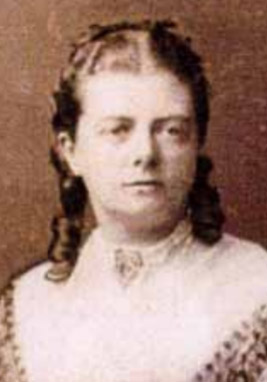
Frances Elizabeth Tripp, known throughout her life as Fanny, was one of the most accomplished botanical illustrators of the nineteenth century and the author of British Mosses, their homes, aspects, structure and uses. First published in 1868 and later expanded in 1874 and 1888, the work appeared in two volumes and became a popular introduction to bryology. It was beautifully produced, with 108 plates etched by Fanny herself on copper from living specimens. The plates were then hand‑coloured at Benjamin Fawcett’s printing works, and the finished books now command high prices whenever they appear for sale. Her illustrations are precise, delicate and scientifically accurate, and they remain admired for their clarity and charm.
Fanny was born on 1 August 1832 and christened at St Sidwell, Exeter. She was the eldest of eight children of the Reverend Robert Henry Tripp and his wife Elizabeth Ann, née Tripp. Her father became vicar of Altarnun in 1842 and held the living for thirty‑three years. The family lived at the vicarage on the edge of Bodmin Moor, and it is easy to imagine that Fanny’s interest in plants began during her childhood walks on the moor. The Tripps were a clerical family of long standing, with connections to Rewe, Kentisbere, Taunton and Portsmouth. Through the Deacon and Upton lines she was descended from the Earls of Portsmouth and from the Reverend James Upton, the noted classicist and schoolmaster.
Her mother’s family was equally distinguished. Elizabeth Ann Tripp was the daughter of George Tripp and Elizabeth Deacon. George had served as a post captain in the Royal Navy but left the service under a cloud after an incident in which his nephew died while he was apparently drunk in command. He retired to Staveley in Yorkshire, where his brother John was rector, and became a prosperous farmer. The Tripps were numerous, and Fanny grew up among a wide network of clerical, naval and professional relations. Her siblings included two clergymen, a civil engineer and several who died young. One nephew, Noel Francis Tripp, became a vicar with a strong interest in natural history and prepared hundreds of bryophyte microscope slides now held at Ludlow Museum.
Fanny did not marry and lived with her parents during her youth and early adulthood. Census returns place her at Altarnun in 1841, 1851, 1861 and 1871. Her maternal grandmother, Frances, left her a considerable estate, and this allowed her to support numerous charitable causes. She became involved in the movement for Italian unification and travelled to Italy with nurses to care for Garibaldi’s troops. Isabella Fyvie Mayo later recalled her as a small woman who spoke with precision and good sense, boarding in London with a lady who kept a fashionable school in Kensington.
Fanny was active in benevolent work throughout her life. She supported the Kyrle Society, founded by Miranda Hill to improve the living conditions of the working class. The Society provided fresh flowers for workhouses and hospital wards and became associated with William Morris and the early National Trust. Fanny’s interest in natural beauty and her skill as an illustrator made her a natural supporter of such causes. She also wrote books for children, adding to her reputation as a popular educator in natural history.
After her father’s death in 1880, Fanny moved to London and was living at 3 Ovington Square at the time of the 1881 census, not far from Margaret Plues, another writer of natural history books. In later years she became deaf and used an ear‑trumpet, which she handled with dignity but little benefit. This loss of hearing saddened her, for she missed the country sounds she had known since childhood and the music that had been important in the vicarage. Her father had been a skilled cellist, and singing was part of family life. Fanny herself became rather overweight in later life and died of a heart attack on 26 December 1890 at 152 Oakley Street, Chelsea, aged fifty‑eight.
Frances Elizabeth Tripp’s legacy lies in her botanical work, particularly British Mosses, which remains admired for its accuracy and beauty. Her etchings, drawn from life and coloured by hand, reflect both scientific discipline and artistic sensitivity. She stands as one of the notable Victorian women who contributed to natural history at a time when formal scientific institutions were largely closed to them. Her life, divided between the moorland parish of Altarnun and the intellectual circles of London, produced work that continues to be valued by botanists, collectors and historians alike.

