

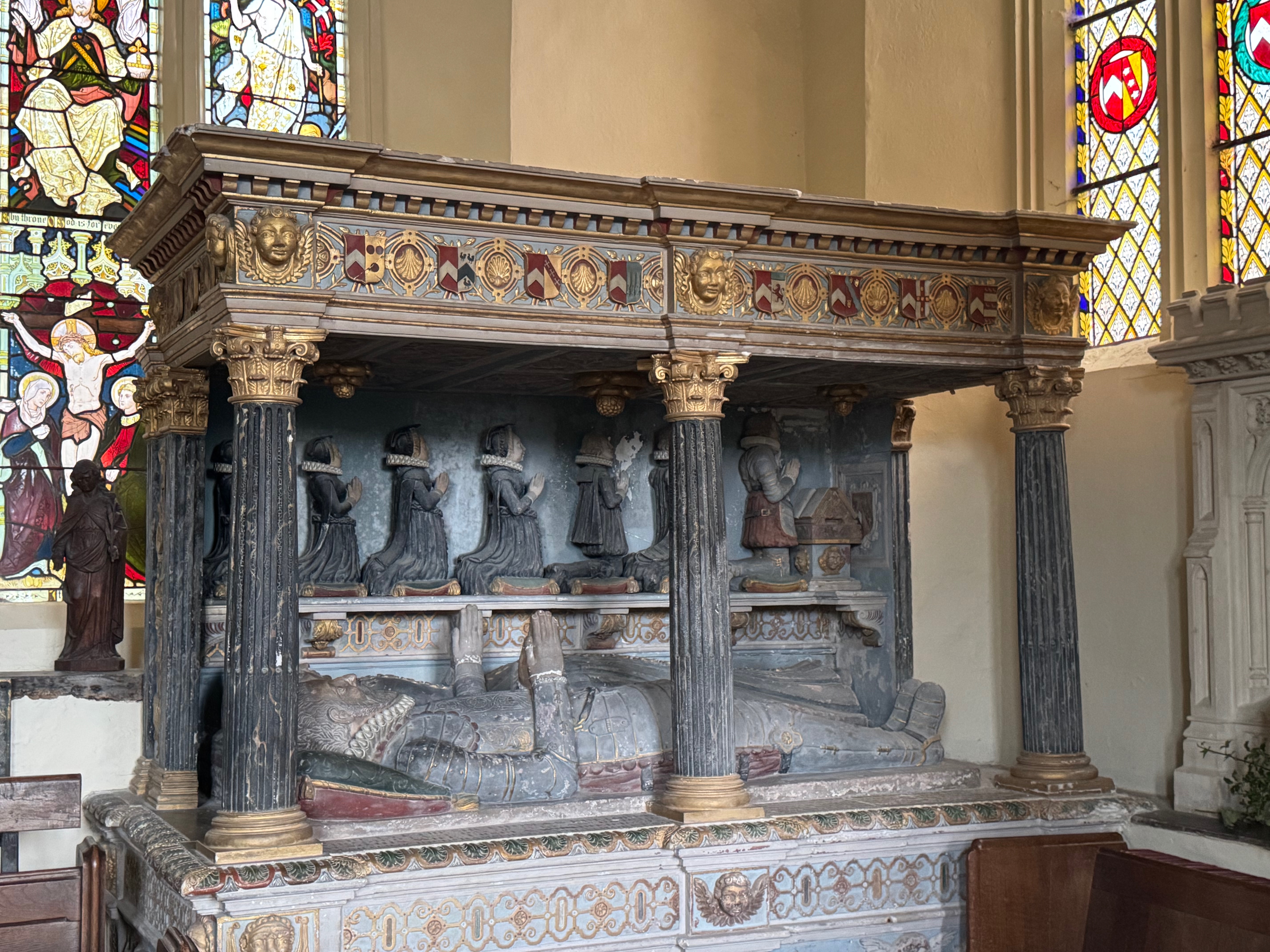
The Fulford Family Tomb in the north aisle of St Mary’s, Dunsford, is one of the most striking examples of Jacobean funerary art in Devon. It commemorates Sir Thomas Fulford (1553–1610) and his wife Ursula Bampfield (d.1639), daughter of Richard Bampfield of Poltimore. The Fulford family, long established at Great Fulford near Dunsford since the reign of Richard I, are among the oldest families in Devon still living at their ancestral seat. Their monument reflects both their status and the artistic fashions of the early 17th century.
The tomb is richly decorated. On its base lie the full-length effigies of Sir Thomas and Lady Ursula. Sir Thomas is shown in steel armour picked out with gilding, wearing a red velvet tunic and Elizabethan ruff, though without gauntlets or helmet. Ursula is dressed in Elizabethan costume, her gown ornamented with gilded quatrefoils, and she too wears a ruff and a flat-topped head-dress. Above them rises a canopy supported by three fluted Corinthian columns at the front and two pilasters at the rear, their capitals and bases gilded. The canopy ceiling is divided into panels with gilded bosses, while the entablature is adorned with cherubs’ heads, shells, and a series of heraldic shields, all crowned by a billeted cornice. Hanging above the monument are an old helmet and sword, reminders of the family’s martial heritage.
Behind the reclining parents stand the kneeling figures of their seven children, three sons and four daughters, each carefully carved and arranged in prayer. A desk is placed before the first figure, and a shield of arms shows the Fulford crest impaling that of Bampfield, underlining the marriage alliance between the two families. The inscription records Sir Thomas’s death in July 1610 and Ursula’s in 1639, and lists their children: Sir Francis, William, Thomas, Bridget (married to Arthur Champernowne of Dartington), Elizabeth (married to John Berriman), and Ann (married to John Sydenham of Somerset). Notably absent is their daughter Mary, whose effigy appears but whose name was omitted from the inscription. Mary married Sir Fernando Gorges, the soldier and adventurer often called the “Father of English Colonization in North America” as founder of the Province of Maine.
The heraldry on the monument is especially rich. Eleven shields are displayed on the entablature, beginning with the Fulford arms (gules, a chevron argent), followed by alliances with families such as Bampfield, Fitzurse, Courtenay, Moreton, Belston, Bozom, St George, Dennis, St Aubyn, and Challons. These coats of arms trace the Fulford family’s web of connections across Devon and beyond, and they add to the monument’s visual splendour.
The monument was restored in 1845 by Colonel Baldwin Fulford whose daughter married into the nearby Bentinck family of Indio House in Bovey Tracey. The original inscription, said to have contained hostile words against the Roman Catholic Church, was replaced at the suggestion of Dr. Oliver, a Catholic friend of the family. This act of restoration not only preserved the monument but also softened its message for a more ecumenical age. The result is a tomb that combines Jacobean artistry with Victorian intervention, standing today as both a family memorial and a work of art of national interest.

